
Menu
Slab vs Pier & Beam Foundation Repair in Austin: Which Method Your Home Needs
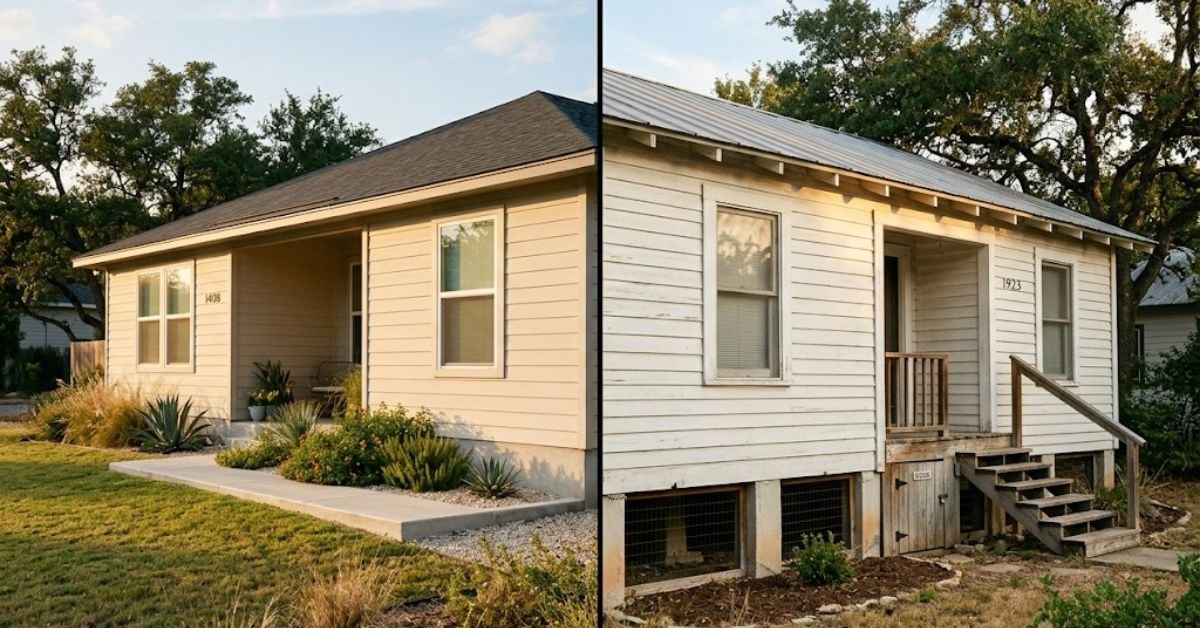
When Austin homeowners start researching foundation repair, most of them run into a fundamental confusion right away: the repair methods, timelines, costs, and even the warning signs are completely different depending on which type of foundation the home has. A slab home and a pier & beam home showing the exact same interior symptoms often need entirely different repair approaches. Yet most foundation repair conversations start from the assumption that you already know which type of foundation you have , and many homeowners don’t.
This guide starts at the actual beginning. What each foundation type is, how you can tell which one is under your Austin home, how each system fails, the repair methods that match each type, and the cost and disruption differences between the two. If you’re at the stage of already knowing you need repair, our post on foundation repair cost in Austin covers current pricing. If you’re trying to understand what’s actually causing the movement, our Central Texas clay soil pillar explains the underlying soil dynamics.
The Two Foundation Types in Austin
Slab-on-Grade Foundations
A slab-on-grade foundation is a solid, monolithic concrete pad poured directly on prepared soil. The concrete sits at (or just above) ground level with no crawl space beneath it. Plumbing runs through the slab from below. Almost every Austin home built after roughly 1975 uses slab-on-grade construction , including the vast majority of homes in Cedar Park, Round Rock, Pflugerville, Leander, Steiner Ranch, and newer sections of Austin proper.
Pier & Beam Foundations
A pier & beam foundation elevates the home’s structural floor system above the ground on a network of piers (vertical supports) connected by beams. This creates a crawl space between the ground and the underside of the finished floor , typically 18-36 inches of clearance. Pier & beam is common in older Austin homes built before the mid-1970s, in Central Austin historic neighborhoods (Clarksville, Hyde Park, Travis Heights, Old West Austin), and on some hillside lots where slab-on-grade wasn’t practical.
How to Tell Which One You Have
Quick Visual Check
- Slab: The lowest visible portion of your exterior wall meets the ground at grade or just above it. You cannot see or access any space beneath the home. The finished floor inside is at essentially the same elevation as the ground outside.
- Pier & beam: The lowest portion of your exterior wall is elevated , typically 18-36 inches above ground level. You’ll see vents around the base of the home, and often an access door or crawl-space opening. The finished floor inside sits noticeably above ground level.
Access Points to Look For
Pier & beam homes always have some form of crawl-space access , often a small door in an exterior wall (often hidden behind landscaping), a hatch inside a closet, or a removable panel in a utility area. If you can identify this access, you have pier & beam. Slab homes have no such access because there’s nothing to access.
Home Age as a Clue
Home age is a strong indicator in Austin: homes built before 1970 are more likely to be pier & beam; homes built after 1980 are almost always slab-on-grade. The 1970s is the transition decade. Home construction records from Travis County or Williamson County appraisal districts will confirm the foundation type.
The Sound Test
On finished flooring: walking on a slab produces a solid, dead sound. Walking on a pier & beam floor often produces a slightly more resonant, hollow sound and may show slight give underfoot. This is a rough indicator only , not definitive.
How Slab Foundations Fail in Austin
Differential Settlement
The most common Austin slab failure. Different parts of the slab settle at different rates because the underlying soil moisture varies across the footprint. One corner or one side drops relative to the rest of the home, tilting the slab and cracking interior walls above.
Heave (Upward Movement)
The opposite of settlement , a section of the slab lifts upward as saturated clay soil beneath it expands. Common at interior sections where plumbing leaks have released water below the slab, or under areas where surface drainage directs water toward the middle of the home.
Slab Cracking
Direct visible cracks in the concrete slab itself, often accompanied by lifted or dropped edges. Serious slab cracking indicates the concrete has failed under sustained load or movement.
Plumbing Line Damage
Slab movement stresses the plumbing lines running through the concrete. Cast iron sewer lines in older slab homes are particularly vulnerable. Repeated slab movement over years often shows up eventually as slab-leak plumbing issues.
How Pier & Beam Foundations Fail in Austin
Failing Shims and Blocks
Traditional pier & beam construction often used wood shims stacked on concrete blocks to fine-tune the height of beams above piers. These shims rot, compress, or slip over decades, causing the floor structure above to sag or shift.
Damaged or Rotted Beams
Wood beams and joists in the crawl space are exposed to moisture, humidity, and occasional pest activity. Aged wood elements can rot, split, or lose structural capacity , causing floor sag in specific areas.
Failing or Cracked Piers
The vertical piers themselves , typically concrete or masonry , can crack, tilt, or lose bearing on the soil beneath. Individual pier failure causes localized floor drop above that pier.
Crawl Space Moisture and Rot
Central Texas humidity trapped in a poorly ventilated crawl space accelerates wood decay throughout the entire under-floor structure. Water infiltration from poor exterior drainage compounds the problem.
Pier Sinking Into Clay Soil
Original piers were often set only a few feet into the soil , well above the depth needed for reliable bearing in expansive Central Texas clay. Piers can sink or shift as the clay cycles through shrink-swell movement.
Repair Methods for Slab Foundations
| Method | Best For | Typical Cost per Unit (Austin 2026) |
|---|---|---|
| Steel push piers | Moderate to major settlement; slab needs stable long-term lift | $1,400-$2,200 per pier installed |
| Concrete pressed pilings | Straightforward settlement; volume repair projects | $500-$900 per piling installed |
| Drilled bell-bottom piers | Critical structural support to bedrock; western Austin metro homes | $2,000-$3,500 per pier installed |
| Helical piers | Load-sensitive situations; homes over compressible soil | $1,800-$2,800 per pier installed |
| Mudjacking / slabjacking | Localized slab lift (garage floor, patio, walkway) | $500-$1,800 per project area |
| Polyurethane foam injection | Precise lift with minimal soil disturbance | $700-$2,200 per project area |
How Slab Repairs Typically Work
The general slab repair sequence: engineer’s assessment identifies the settlement pattern and specifies pier count and locations. Excavation creates access at each pier location (typically at the exterior perimeter, sometimes inside the home through the slab). Piers are installed and connected to the foundation’s grade beam or slab. Hydraulic jacks lift the settled sections back toward original elevation. Excavations are backfilled and landscaping restored. Interior cosmetic repair (patching cracks, re-caulking, tile repair) follows after the structural work.
Repair Methods for Pier & Beam Foundations
| Method | Best For | Typical Cost (Austin 2026) |
|---|---|---|
| Shim adjustment and replacement | Level correction where existing piers are sound but shims have compressed | $3,500-$10,000 total project |
| Beam or joist replacement | Structural wood elements rotted, split, or damaged | $300-$800 per linear foot replaced |
| New crawl space piers | Existing piers insufficient in number or capacity | $400-$900 per new pier installed |
| Existing pier replacement | Damaged concrete or masonry piers replaced with modern equivalents | $600-$1,200 per pier replaced |
| Crawl space vapor barrier | Moisture control preventing further wood decay | $1,500-$4,000 for typical footprint |
| Crawl space drainage improvement | Water infiltration into the crawl space | $2,000-$8,000 depending on scope |
How Pier & Beam Repairs Typically Work
The general pier & beam repair sequence: contractor accesses the crawl space and assesses each pier, beam, and joist. Specific issues are identified , sagging areas, failed shims, damaged wood, moisture problems. A repair plan addresses each item individually. Actual work happens in the crawl space with hand tools, hydraulic jacks, and replacement lumber. Interior floor level is corrected by adjusting shims and adding new piers where needed. Moisture control and drainage improvements protect the repair long-term.
Cost Comparison , Same Symptom, Different Foundation Type
The identical exterior symptom , say, one corner of the home dropped an inch , leads to very different repair costs depending on foundation type.
| Scenario | Slab Foundation Cost | Pier & Beam Foundation Cost |
|---|---|---|
| Minor corner settlement (1 area) | $2,500-$5,500 (4-6 pilings) | $1,500-$4,000 (shim adjust) |
| Moderate one-wall settlement | $9,000-$22,000 (6-10 steel piers) | $4,000-$10,000 (multi-pier shim/pier work) |
| Significant multi-side movement | $15,000-$33,000 (10-15 piers) | $8,000-$20,000 (extensive shim/pier work) |
| Major whole-house scope | $22,000-$55,000+ (16+ piers) | $15,000-$40,000+ (major structural work) |
| Localized slab lift only | $500-$1,800 (mudjacking) | N/A , different repair type |
Why Pier & Beam Is Often Cheaper to Repair
Access is the main driver. Pier & beam repair happens inside the existing crawl space , no excavation to reach the foundation, no interior slab cutting, no disruption to interior finishes. Slab repair typically requires excavating exterior perimeter to access grade beam, or cutting through the slab for interior piers. Excavation and slab access work adds substantial labor time and cost to slab projects.
When Pier & Beam Repair Gets Expensive
Extensive structural damage , multiple failed beams, joists, and piers combined with moisture problems , can push pier & beam repair into slab-repair territory. Very old pier & beam homes with decades of accumulated deferred maintenance often require substantial structural work that adds up quickly.
Timeline Comparison
Slab Foundation Repair Timeline
- Assessment and engineering: 1-2 weeks
- Permit processing: 2-4 weeks (varies by municipality)
- On-site work (typical moderate scope): 3-5 days
- Backfill and restoration: 1-2 days
- Interior cosmetic repair: 3-7 days
- Total elapsed time: 5-9 weeks typical
Pier & Beam Repair Timeline
- Assessment and engineering: 1-2 weeks
- Permit processing: Often not required for repair work only
- On-site work (typical moderate scope): 2-4 days
- Interior cosmetic repair: 1-3 days (less needed than slab)
- Total elapsed time: 2-5 weeks typical
Disruption Comparison
Slab Foundation Repair Disruption
Exterior work zones around the home perimeter, excavation dirt piles temporarily on the property, interior work if piers are installed through the slab (furniture must be moved, temporary flooring removal), noise from hydraulic equipment during pier installation, and post-project landscape restoration where excavation occurred. Most homeowners can stay in the home during slab repair, though comfort is reduced.
Pier & Beam Repair Disruption
Most work happens in the crawl space with minimal above-grade visibility. Some interior floor squeaking or minor movement during shim adjustment. Less landscape disruption than slab repair. Homeowners typically don’t notice significant disruption above ground level.
Which Foundation Is “Better” , And Which Is Easier to Repair?
Better Original Choice
Neither is objectively superior. Slab construction dominates modern Austin building because it’s faster and cheaper to build, provides better thermal mass, and works well in relatively flat suburban lots. Pier & beam construction was preferred historically because it works on hilly terrain, provides accessible utilities, and can be adjusted over the home’s life.
Easier to Live With
Slab homes generally have fewer ongoing maintenance concerns , no crawl space to monitor, no ventilation to manage. Pier & beam homes require periodic crawl space inspection but are more accessible for plumbing and electrical modifications.
Easier to Repair
Pier & beam is usually easier and cheaper to repair for equivalent movement severity. Because the foundation system is designed to be adjustable, shim and pier modifications don’t require the excavation and structural intervention that slab repair does.
More Common in Austin
Slab-on-grade dominates the modern Austin metro , probably 85%+ of all residential foundations. Pier & beam remains meaningful in older Central Austin neighborhoods and specific historic districts.
Signs That Indicate Slab vs Pier & Beam Issues
Slab Foundation Warning Signs
- Diagonal cracks in walls radiating from door and window corners
- Doors that bind or won’t close, especially in extreme wet/dry seasons
- Stair-step cracks in exterior brick veneer
- Cracks in the visible portion of the slab or grade beam outside the home
- Tile floor cracks that follow a straight line across a room
- Gaps opening between countertops and walls
Pier & Beam Foundation Warning Signs
- Sagging floors detectable while walking (springy or “bouncy” feel)
- Slope in floors when a marble rolls on its own
- Visible gaps between the floor and baseboards in specific rooms
- Bouncing or vibration in floors when appliances run
- Musty odors from the crawl space
- Visible sag when viewing the home’s floor line from a distance
- Cracks in interior walls, though less common than in slab homes
For the complete warning-signs framework across both types, see our post on foundation trouble warning signs in Central Texas.
Both Types Need Prevention , Same Underlying Practices
Regardless of foundation type, the practices that prevent movement damage are the same in Austin’s clay-heavy soil conditions: consistent site drainage away from the foundation, functional gutters and downspouts, tree root management for foundation-adjacent trees, and consistent soil moisture. Our post on how often to water your foundation in Central Texas covers the moisture side, and the Central Texas clay soil pillar covers the comprehensive protection framework.
Serving Austin Metro Foundation Work
We handle both slab and pier & beam foundation work across the Austin metro. Slab repair projects are common in Cedar Park, Round Rock, Pflugerville, Leander, and Steiner Ranch. Pier & beam work concentrates in older Central Austin neighborhoods. Our Cedar Park foundation repair guide covers the local specifics for that submarket. Neighborhoods with the highest concentration of pier & beam homes we serve include Clarksville, Hyde Park, Bouldin Creek, Travis Heights, and Old West Austin.
Why Tex Land Construction
Tex Land Construction is a BBB Accredited, 5.0-star rated, GuildQuality-member exterior contractor with foundation repair as part of our full-service exterior scope. We handle both slab and pier & beam repair projects and give homeowners honest guidance on which approach fits their specific home. We work with independent licensed structural engineers on assessments and stand behind our repair work with transferable warranty coverage.
You can review our published business information on our Hotfrog Austin home improvement listing, our Storeboard business page, and our Issuu portfolio. We offer a 5% discount on all services for military veterans, active duty service members, first responders, and senior homeowners.
Call 512-808-6882 or visit our contact page to schedule a free foundation inspection.
Frequently Asked Questions
How do I know if I have a slab or pier & beam foundation?
The quickest test: look at the base of your exterior wall. Slab foundations meet the ground at grade or just above, with no visible space beneath. Pier & beam foundations sit elevated 18-36 inches above ground with a crawl space beneath, visible vents around the base, and often an access door. Home age is another strong indicator: Austin homes built before 1970 are often pier & beam; homes built after 1980 are almost always slab-on-grade. Travis County or Williamson County appraisal district records confirm the foundation type.
Is slab or pier & beam better for Austin homes?
Neither is objectively better. Slab-on-grade construction dominates modern Austin (85%+ of homes) because it’s faster and cheaper to build, provides better thermal mass, and suits flat suburban lots. Pier & beam works better on hilly terrain, provides accessible utilities beneath the home, and offers more adjustability over time. Both foundation types perform well when built and maintained properly in Central Texas conditions. Neither foundation type is superior for Austin’s expansive clay soil , both need proper drainage, moisture management, and periodic assessment.
Which foundation type is cheaper to repair?
Pier & beam is usually cheaper to repair for equivalent movement severity. Because the foundation is designed to be adjustable, shim and pier modifications happen inside the existing crawl space without the excavation, slab cutting, and interior disruption that slab repair requires. Typical moderate one-wall repair runs $4,000-$10,000 for pier & beam versus $9,000-$22,000 for slab foundations. Very extensive pier & beam damage can push costs higher, but for equivalent problems, pier & beam projects generally cost less.
What are the main repair methods for slab foundations in Austin?
Four primary methods: steel push piers hydraulically driven to bearing depth ($1,400-$2,200 per pier), concrete pressed pilings pressed to bearing capacity ($500-$900 per piling), drilled bell-bottom piers with wider bases for critical structural support ($2,000-$3,500 per pier), and mudjacking or polyurethane foam injection for localized slab lifts ($500-$2,200 per project area). The right method depends on soil conditions, settlement pattern, foundation depth requirements, and long-term stability priorities.
What are the main repair methods for pier & beam foundations?
Common approaches: shim adjustment and replacement to correct floor levels ($3,500-$10,000 total project), beam or joist replacement where wood elements have rotted or failed ($300-$800 per linear foot), addition of new crawl space piers to increase support ($400-$900 per new pier), replacement of failed piers ($600-$1,200 per pier), and moisture-control improvements including vapor barrier installation and crawl space drainage. Most pier & beam repairs combine several of these approaches based on specific damage found during crawl space inspection.
How long does slab vs pier & beam foundation repair take?
Slab foundation repair takes 5-9 weeks total elapsed time typically: 1-2 weeks for engineering assessment, 2-4 weeks for permit processing, 3-5 days of on-site work for moderate scope, 1-2 days for backfill and restoration, and 3-7 days for interior cosmetic repair. Pier & beam repair typically takes 2-5 weeks total: 1-2 weeks for assessment, minimal permit processing time (often not required), 2-4 days on-site work, and 1-3 days interior cosmetic repair. Pier & beam projects are generally faster because they don’t require excavation or structural permit review.
Free Foundation Type Assessment
Not sure what you have? We identify your foundation type and give an honest read on what repair, if any, is warranted. BBB Accredited. 5.0 Google rating.
Schedule Free Assessment →Let’s talk about your home.
Schedule a free consultation →