
Menu
How Often Should You Water Your Foundation in Central Texas?
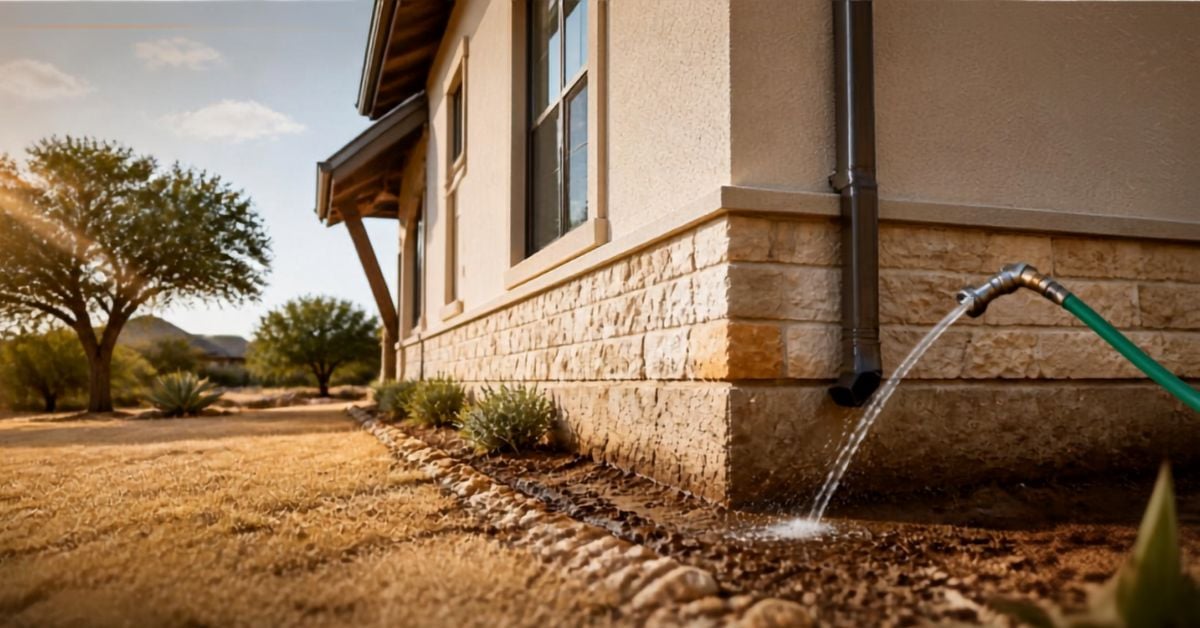
If you own a home in the Austin metro, foundation watering isn’t optional. It’s a routine maintenance task on the same tier as changing HVAC filters or cleaning gutters. Skip it during a bad Central Texas summer and the expansive clay under your slab will dry, shrink, and drop, pulling drywall cracks, sticking doors, and structural stress along with it.
The good news is that consistent foundation watering is cheap, easy, and one of the highest-return preventive measures a homeowner in this region can take. The bad news is that most homeowners either don’t do it at all, or they overwater and cause a different set of problems. This guide covers the specifics: when to start, how often, how much water, what setup works best, and how to know if you’re doing it right.
If you’re not sure whether you already have foundation issues that go beyond routine watering, our companion post on foundation trouble warning signs in Central Texas homes covers what to watch for. This article is specifically about the watering side of prevention.
Why Foundation Watering Matters So Much Here
The greater Austin metro sits on some of the most challenging soil in the country for residential foundations. Houston Black clay and related expansive soils dominate the region, and they behave in a very specific way: when they’re wet, they swell; when they’re dry, they shrink, sometimes dramatically.
A slab foundation is asked to stay perfectly level while the ground beneath it goes through those expansion and contraction cycles year after year. Small movements it can handle. Big, uneven movements, where one side of the slab is on damp soil and the other side is on bone-dry soil, cause the differential settlement that produces cracks, gaps, sticky doors, and eventually structural repair bills.
The point of foundation watering isn’t to keep the soil saturated. It’s to keep the soil moisture level stable. If the whole perimeter of your slab is consistently at similar moisture content, not soaked, not desert-dry, the soil moves less, and the slab stays closer to level.
When to Start Watering Your Foundation
Foundation watering isn’t a year-round activity for most Central Texas homes. It’s driven by weather, and specifically by how dry the soil around your foundation is getting. Here are the triggers.
Trigger 1: The Soil Around Your Foundation Has Pulled Away
Walk around your home and look at the joint where the soil meets the foundation slab. In a normal wet spring, the soil is snug against the slab. As summer progresses and the clay shrinks, a gap opens up. Once you can see a visible gap between the soil and the slab, typically 1/4″ or wider, the soil has shrunk enough that watering should start.
Trigger 2: Cracked Soil Around the Perimeter
Another early sign. The soil surface within a few feet of your foundation shows visible surface cracks, not massive fissures, but a distinct network of small cracks in the top inch or two of clay. This means the near-surface soil is losing moisture faster than deeper soil, and the differential is starting to matter.
Trigger 3: Weather-Based Rules of Thumb
- Two consecutive weeks of temperatures above 95°F with no significant rain, start watering.
- Any declared drought stage in your part of the Austin area, start watering (subject to any watering restrictions; foundation watering with a soaker hose is typically exempt or limited but permitted).
- June, July, August, September in a normal Central Texas year, plan on watering most days.
When You Do NOT Need to Water
Foundation watering is generally not needed in November through March in a normal wet Central Texas winter, the soil is naturally at good moisture levels. It’s also not needed during and immediately after significant rainfall (a good storm gives your foundation a day or two of natural watering). Overwatering during wet stretches is one of the most common mistakes homeowners make.
How Often to Water, By Season
Here’s a general schedule for a typical Central Texas year. Adjust based on actual conditions, not the calendar.
| Season / Condition | Watering Frequency | Duration per Session |
|---|---|---|
| Peak summer (Jun-Sep), no rain | Every 1-2 days | 20-45 minutes per soaker hose zone |
| Peak summer, occasional rain | Every 2-3 days | 20-30 minutes per zone |
| Late spring / early fall | Every 3-5 days | 15-30 minutes per zone |
| Mild dry stretch (Oct, Apr, May) | Every 5-7 days if soil is dry | 15-20 minutes per zone |
| Wet season (Nov-Mar) | Usually not needed | , |
| Extreme drought stage | Daily | 30-45 minutes per zone |
| After heavy rain | Skip 2-3 days | , |
The Underlying Principle
You’re aiming for consistent soil moisture, damp, not soaked. The right analogy is a wrung-out sponge, not a puddle. If you dig down 4 to 6 inches near the foundation and the soil crumbles, you need to water more. If you dig down and the soil is muddy or you can squeeze water out of it, you’re overwatering.
How Much Water, Depth Matters More Than Volume
The goal isn’t to soak the surface. It’s to deliver water deep enough into the soil that the clay layer immediately under your slab benefits. Surface watering evaporates in Central Texas summers before it does anything useful.
The Depth Target
You want moisture to reach roughly 18 to 24 inches deep around the perimeter of your foundation. That depth is where the clay is actively expanding and contracting under your slab.
How to Check Depth
Push a long screwdriver or a soil moisture probe into the ground about 2 feet from the foundation. In dry conditions it stops after just a few inches. After proper watering, it should push in a foot or more with steady pressure. That’s how you know the moisture is penetrating deep enough to matter.
Watering Volume Guidance
A standard 50-foot soaker hose at typical Central Texas water pressure delivers roughly 25 to 50 gallons per hour, depending on the hose. Running it for 30 minutes puts down 12 to 25 gallons along a 50-foot foundation section, enough to soak in and reach depth without pooling. Longer runs are needed on heavy clay areas where infiltration is slow.
The Best Watering Setup: Soaker Hose, Not Sprinklers
Not all watering methods work for foundations. The right setup is specific.
Soaker Hose (Recommended)
A porous rubber soaker hose laid on the ground about 18 inches out from the foundation, encircling the entire perimeter. Water seeps out slowly along the full length, soaking evenly. This is the standard setup and by far the most effective for foundation watering in Central Texas.
- Pros: Even coverage, slow deep soaking, minimal evaporation, works with a simple timer.
- Cons: Needs to be replaced every 3-5 years as it clogs or splits, must be repositioned occasionally.
Drip Irrigation
Individual emitters spaced along a supply line 18″ from the foundation. Slightly more precise than a soaker hose but more complex to set up and maintain. Reasonable option if you’re already running drip irrigation in your landscape.
Sprinklers (NOT Recommended)
Overhead sprinklers are a poor choice for foundation watering. Most of the water evaporates before soaking deep, sprays hit the siding and can damage it, and coverage is uneven, the near side of the foundation gets more water than the far side. If your yard has an automatic sprinkler system, do not rely on it for foundation moisture.
Hand Watering (Emergency Use Only)
Fine for a quick catch-up on a dry spot, but not a sustainable routine. You’ll almost always underwater the depth needed to matter.
Where to Place the Soaker Hose
Placement matters as much as the timing.
Distance From Foundation
Place the soaker hose 12 to 18 inches out from the foundation. Too close (touching the slab) can cause water to pool against the foundation and damage the interior side of the slab. Too far out (more than 3 feet) and the moisture doesn’t reach the soil immediately under your slab in time to matter.
All Four Sides, Not Just the Sunny Sides
Every side of the foundation should get watered, not just the south and west. The reason is even soil moisture: if you only water the sunny sides, the shaded sides remain relatively wet from rain and dew while the sunny sides get artificially wet. That differential can cause more movement than doing nothing at all.
Where NOT to Water
- Right up against the slab surface. Water should be soaking in, not pooling.
- Under trees or major shrubs where roots will preferentially take the water.
- On sloped ground running toward the foundation, this causes water to sheet against the slab rather than soak deep.
- Over any known plumbing leak (address the leak first; foundation watering does not fix leaks).
Signs You’re Doing It Right
How do you know it’s working?
- The soil around your foundation stays snug against the slab even in July and August, no visible gap opening up.
- Interior doors that historically stick in summer either stop sticking or stick less noticeably.
- A screwdriver or moisture probe pushes 12+ inches into the ground near the foundation with reasonable pressure.
- Drywall cracks that appear and disappear seasonally either narrow or don’t open as wide.
- No pooling water, no muddy patches, no water running down your driveway or sidewalks from over-application.
Signs You’re Overwatering
Overwatering is the second most common problem after underwatering. Signs include:
- Visible standing water or muddy soil more than an hour after watering ended.
- Moss, mildew, or fungal growth against the foundation slab.
- Water bill jumping significantly higher than the seasonal norm.
- Landscape plants near the foundation showing signs of root rot (yellowing, wilting despite wet soil).
- Visible cracks appearing in the slab or exterior siding from the opposite direction, the soil is now over-expanding and pushing the foundation upward.
Common Foundation Watering Mistakes
Watering Only the Front of the House
Homeowners who add foundation watering as an afterthought often only water the front yard because that’s where the soaker hose is easy to run. The result is a home with damp soil on one side and dry soil on the other, worse than watering nowhere at all. All four sides of the foundation need consistent moisture.
Running Sprinklers Only
Assuming that a standard lawn irrigation system takes care of foundation watering. It doesn’t. Sprinklers water grass, not slabs, and they don’t deliver moisture deep enough to help.
Watering During Wet Weather
Running the timer through fall rains creates the same expansive-clay problem in reverse. When the soil is naturally wet, additional watering pushes it toward saturation and can cause the slab to heave upward.
Waiting Until the Damage Is Visible
The point of watering is prevention. Waiting until you see drywall cracks or sticky doors before you start watering means you’re addressing the symptom while the underlying movement continues.
Set-and-Forget Timers Without Adjustment
A timer set to “3 days a week for 30 minutes” and never touched will overwater during rainy stretches and underwater during extreme heat. Adjust seasonally, and skip runs after significant rainfall.
When Watering Isn’t Enough
Foundation watering is preventive. If your home is already showing signs of active foundation movement, multiple diagonal drywall cracks radiating from door corners, doors that no longer latch, a chimney pulling away from the house, watering alone won’t reverse the damage. It may slow further movement, but you need a proper foundation assessment. See our post on foundation warning signs for how to distinguish routine seasonal cracks from active movement.
The pattern to watch for: symptoms that keep getting worse year over year rather than appearing and disappearing seasonally. Progressive damage means the slab is still moving despite your maintenance, and a professional evaluation is the next step.
Foundation Watering by Austin Neighborhood
The soil composition and lot conditions vary considerably across the metro. Here’s a rough guide to what to expect.
Western and Northwestern Metro (Higher Vigilance)
Homes in Westlake Hills, Steiner Ranch, Lost Creek, and the western edges of Cedar Park and Leander often sit on cut-and-fill lots, where one section of the foundation is on native limestone bedrock and another is on brought-in fill dirt. These homes need particularly attentive watering because the moisture behavior on the two sides of the foundation is naturally different.
Central Metro (Standard Vigilance)
Homes in older Rollingwood, central Austin neighborhoods, and older Round Rock typically sit on deeper Houston Black clay. Standard soaker-hose perimeter setup works well.
Eastern and Northeastern Metro
Homes in Pflugerville, eastern Round Rock, and East Austin often have the deepest expansive clay in the metro. Watering discipline is especially important because the clay’s shrink-swell range is larger.
Why Tex Land Construction
Tex Land Construction is a BBB Accredited, GuildQuality member, and 5.0-star rated exterior contractor. While we focus primarily on siding, roofing, windows, and painting, foundation-related issues frequently show up first in the exterior envelope, and we regularly help Austin homeowners connect the dots between drainage, foundation moisture management, and the cosmetic symptoms they’re seeing on walls and trim.
Our team can assess how your foundation is affecting your exterior, siding gaps, sticking windows, cracked trim, or drainage patterns, and give you a straight answer on whether the fix is a watering routine adjustment, a drainage correction, or a professional foundation evaluation.
You can review our published business information and project examples on our Hotfrog Austin home improvement listing, our Storeboard business page, and our Issuu portfolio. We offer a 5% discount on all services for military veterans, active duty service members, first responders, and senior homeowners.
Call 512-808-6882 or visit our contact page to schedule a free assessment for your Austin-area home.
Frequently Asked Questions
How much does foundation watering cost per month in Austin?
Modest. A properly set soaker hose running 30 minutes per day for the peak summer months typically adds $15 to $40 to your monthly water bill, depending on hose length and how many zones you’re running. That’s a small maintenance cost compared to the potential thousands in foundation repair from a dry-season slab drop.
Do I need to water in the winter in Central Texas?
Usually no. From roughly November through March, natural rainfall in a normal Central Texas year keeps the soil at good moisture levels. The exception is unusually dry winters, if January and February are bone-dry with no significant rain and daytime temps are climbing into the 70s and 80s, run a brief watering cycle every 7-10 days to keep the soil from drawing down too far.
Will foundation watering fix cracks I already have?
It may narrow seasonal cracks, but it won’t reverse existing structural damage. If your cracks are cosmetic and open/close with the seasons, consistent watering often reduces how wide they open in summer. If your cracks are structural, diagonal from door corners, wider than a business card edge, growing over time, watering is a good habit going forward but the existing damage needs a professional foundation assessment.
Can I use my sprinkler system for foundation watering instead of a soaker hose?
Not effectively. Sprinklers deliver most of their water in the top few inches of soil, and much of it evaporates in Central Texas summer heat. They also can’t reliably concentrate water 12-18 inches out from the foundation, they cover the whole yard. A dedicated soaker hose along the perimeter is inexpensive to set up and dramatically more effective for foundation moisture management.
What about watering restrictions during a drought?
Most Austin-area municipalities exempt or permit foundation watering with a soaker hose or drip system during drought watering restrictions, even when lawn sprinkling is prohibited. Check your specific city’s water utility rules, Austin Water, Round Rock Utilities, Pflugerville Water Department, and others all publish specific guidance during Stage 2 or higher restrictions. Foundation watering is recognized as a home-protection activity, not a discretionary use.
My soaker hose is old. How do I know when to replace it?
Soaker hoses generally last 3-5 Central Texas summers before they start clogging, splitting, or delivering uneven water. Signs it’s time to replace: sections that no longer seep, dry patches along the length of the hose, visible splits or leaks, or a dramatic drop in flow rate. Replacement is inexpensive, $20 to $40 per 50-foot hose.
Free Assessment for Foundation-Related Exterior Issues
Honest evaluation of siding gaps, sticky windows, and drainage issues that trace back to foundation moisture. BBB Accredited. 5.0 Google rating.
Schedule Free Assessment →Let’s talk about your home.
Schedule a free consultation →