
Menu
How Much Does Foundation Repair Cost in Austin? (2026 Homeowner’s Guide)
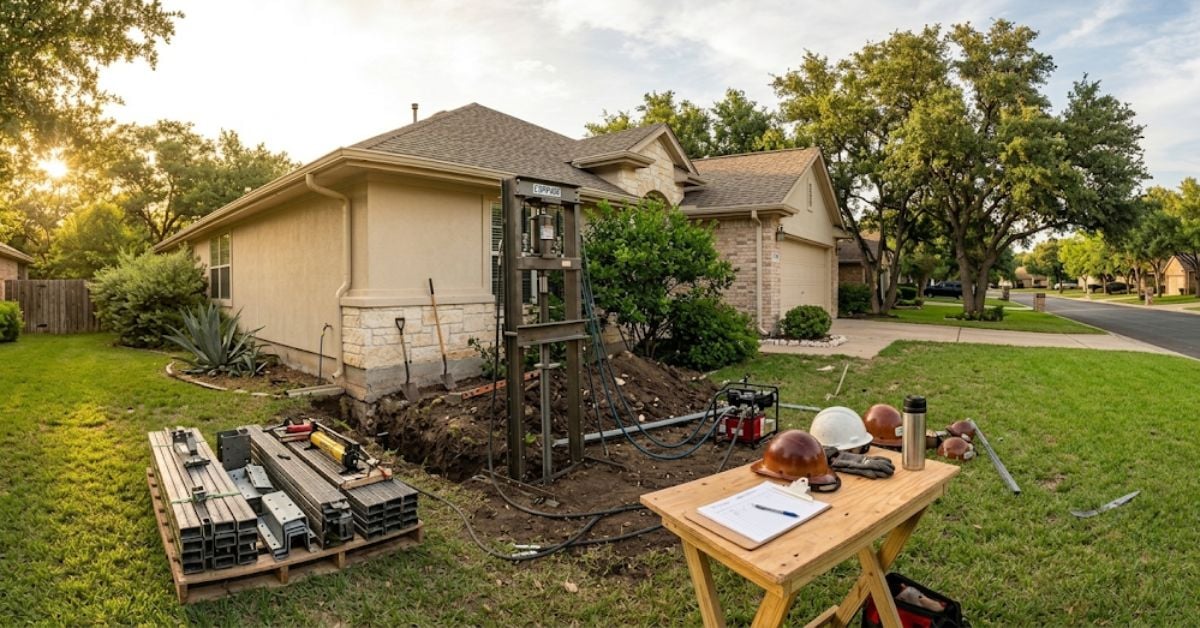
Foundation repair pricing in Austin has one of the widest legitimate ranges of any home improvement category. The same visible symptom, say, a dropped corner producing diagonal drywall cracks, can generate quotes ranging from $2,500 to $35,000 depending on the pier system proposed, the number of piers, the underlying soil condition, and the contractor’s business model. The gap between “honest fair quote” and “inflated shakedown” is often much smaller than that spread suggests, but you need to know what to look for.
This guide walks through real 2026 foundation repair costs in the Austin metro. Pier types and per-pier pricing, cost by project scope, the factors that move the total up or down, why homeowner’s insurance almost never covers it, and how to recognize an inflated estimate. If you’re still trying to figure out whether repair is even needed, our companion post on foundation trouble warning signs in Central Texas homes covers that side of the picture.
The 2026 Cost Ranges at a Glance
Before we go deep, here are the headline numbers Austin homeowners will see this year.
| Scope of Work | Typical Austin Cost (2026) |
|---|---|
| Foundation assessment / engineer report only | $300 – $900 |
| Drainage correction (no piering) | $1,500 – $6,000 |
| Concrete pressed piers (per pier installed) | $300 – $600 |
| Steel push piers (per pier installed) | $1,200 – $2,200 |
| Helical piers (per pier installed) | $1,600 – $3,000 |
| Small spot repair (3-5 piers) | $2,500 – $9,000 |
| Single-side / corner correction (8-12 piers) | $6,000 – $18,000 |
| Half-perimeter correction (15-20 piers) | $10,000 – $30,000 |
| Full perimeter repair (25-40 piers) | $18,000 – $60,000+ |
| Full pier-and-beam re-leveling (large home) | $15,000 – $50,000+ |
These ranges reflect quality work by licensed foundation contractors in the Austin metro. Bargain-basement operators quote lower and often leave problems in their wake; premium boutique firms come in at the higher end with engineering oversight and stronger warranties. Both extremes have tradeoffs.
The Three Pier Systems, What Each Actually Is
The single biggest cost driver on foundation repair is which pier system is used. There are three mainstream approaches in the Austin market, and their per-pier costs vary by a factor of 5 or more.
Concrete Pressed Piers
What it is: Cylindrical concrete cylinders (typically 6″ diameter, 12″ long) are hydraulically pressed one on top of the other into the ground beneath the foundation, stopping when refusal is reached or design depth is achieved. A cap block is then set under the foundation grade beam and load-transferring hardware installed.
Cost per pier installed: $300-$600 in the Austin market.
Best for: Straightforward slab settlement situations where the soil is consistent expansive clay and the load requirements are moderate. Dominates the Austin foundation repair market by volume.
Limitations: Cannot reliably reach load-bearing strata below variable fill or through significant obstructions. Depth reached is not always measurable. Warranty terms vary.
Steel Push Piers
What it is: Solid or hollow steel pier sections (typically 3″ diameter, 3′ long) are hydraulically driven into the ground using the home’s own weight as reaction force. Each pier is pushed to bedrock or to a measurable load-bearing capacity. Hydraulic jacks then lift the foundation onto the piers.
Cost per pier installed: $1,200-$2,200 in the Austin market.
Best for: Homes on shallow soil over bedrock, cut-and-fill lots, situations where load capacity needs to be measurable, and repairs that need to reach known load-bearing strata rather than just refusal depth. Common in western Austin metro neighborhoods like Westlake Hills, Steiner Ranch, and Lost Creek.
Limitations: Higher per-pier cost. Requires the structure to have sufficient dead load to drive the piers.
Helical Piers (Screw Piers)
What it is: Steel shafts with helical (screw-like) plates on the leading end are mechanically screwed into the ground with hydraulic torque motors. The plates provide the load-bearing capacity, and the pier depth is precisely engineered.
Cost per pier installed: $1,600-$3,000 in the Austin market.
Best for: Light structures where push piers can’t be reacted against, additions to existing homes, sites with contaminated or restricted soil access, and situations where load capacity needs to be engineered rather than assumed.
Limitations: Highest per-pier cost. Overkill for many residential slab settlement situations.
Cost by Project Scope
Assessment Only
Before any repair, a legitimate foundation contractor or engineer should perform a full assessment: floor elevation survey with a manometer or laser level, exterior and interior documentation of visible symptoms, drainage evaluation, and a written report of findings. Some contractors offer this free as part of an estimate; independent structural engineer reports typically cost $300-$900. On any repair over $10,000, having an independent engineer’s report before signing is worth the fee.
Drainage Correction Only (No Piering)
Often overlooked, but one of the most important interventions in Central Texas. If the foundation movement is being driven by uneven moisture around the perimeter, bad gutter runoff, negative grading, or irrigation malfunction, fixing those root causes may eliminate the need for piering entirely. Costs range from $1,500 for basic gutter/downspout redirection to $6,000 for full grading and drainage system installation. See our post on how often to water your foundation in Central Texas for the moisture management side.
Spot Repair (3-5 Piers)
A single dropped corner, a specific section of dropped slab, or localized movement in one area. Concrete pressed piers: $2,500-$4,500. Steel push piers: $5,000-$9,000.
Corner or Single-Side Correction (8-12 Piers)
A full corner of the home or an entire side needs lifting. Common when one side of a home is on cut soil and the other is on fill. Concrete: $6,000-$10,000. Steel: $12,000-$18,000.
Half-Perimeter Correction (15-20 Piers)
Larger sections requiring engineered load transfer. Common on homes over 15 years old in Central Texas. Concrete: $10,000-$16,000. Steel: $22,000-$30,000.
Full Perimeter Repair (25-40 Piers)
The whole home needs to be brought back to a stable elevation. Concrete: $18,000-$32,000. Steel: $35,000-$60,000+.
Pier-and-Beam Re-Leveling
Older homes with pier-and-beam foundations (rather than slabs) require different work, shimming, adjusting existing piers, replacing rotted beams. Pricing is per beam adjustment and often runs $15,000-$50,000+ for a full re-leveling on a larger home.
What Actually Drives the Cost Up
Number of Piers Required
The single biggest variable. Each pier adds its full per-pier cost plus a small amount of shared setup and cleanup. A quality assessment identifies the minimum number of piers needed to stabilize the foundation, not the maximum the contractor can sell you.
Pier System Chosen
As shown in the tables above, steel push piers cost roughly 3-4 times what concrete pressed piers cost. Helical piers cost even more. The system chosen should match the soil conditions and load requirements, not the contractor’s preferred markup.
Depth Required
Piers need to reach a load-bearing stratum. In parts of the Austin metro with shallow limestone (western neighborhoods), that depth is 5-15 feet. In deep clay areas (parts of Pflugerville, east Round Rock, and east Austin), depth may extend 20-35 feet. Deeper piers cost more.
Access Constraints
Piers installed through finished flooring inside the home cost more than piers installed around the exterior. Landscaping removal, deck removal, or utility relocation adds to the total. Homes with tight lot access require more manual labor.
Home Weight and Load Requirements
Two-story homes require more load-bearing capacity per pier than single-story homes. Brick veneer homes are heavier than fiber cement or vinyl siding. Heavier structures may require more piers, deeper piers, or the steel push pier system rather than concrete.
Additional Repairs During the Job
When piers are installed and the foundation is lifted, some collateral repair is normal, reset door frames, patch drywall cracks that no longer close, re-caulk exterior siding, and touch up interior finishes. Some contractors quote these separately; others include them. Confirm before signing.
What Insurance Actually Covers (Almost Never What You Hope)
Standard Homeowners Policies Exclude Foundation Movement
Virtually all Texas homeowners insurance policies exclude damage caused by earth movement, soil expansion, and normal settlement. Since expansive clay is the dominant driver of Austin foundation issues, this means the vast majority of foundation repair costs fall entirely on the homeowner. Do not budget for insurance to help.
The Plumbing Leak Exception
The one significant exception: if foundation damage was demonstrably caused by a plumbing leak under the slab, a broken water line, a sewer line failure, or similar, some policies cover the foundation repair costs required to fix the resulting damage, as well as the plumbing repair itself. Getting this covered requires clear documentation that the leak caused the damage, not the other way around. Always call a plumber for a full leak test before accepting a foundation repair diagnosis.
Structural Damage From a Covered Peril
If a covered event, like a vehicle impact, fire, or specific storm damage, caused the foundation damage, standard policies may cover the repair. This applies to a small minority of Austin foundation cases.
How to Spot an Inflated Estimate
Diagnosing Every Home as Needing Repair
Some large foundation companies structure their sales incentives around per-visit conversion rates. If every home they inspect ends up needing $20,000+ of piering, the diagnosis is being driven by the sales model, not the actual foundation. Legitimate contractors regularly conclude that no piering is needed, just drainage correction or moisture management. Get a second opinion whenever a first-visit diagnosis seems dramatic.
Push to Sign Same-Day
Any pressure to sign a contract during the assessment visit is a red flag. Foundation repair decisions warrant a few weeks of comparison and reflection. Contractors who pressure you toward same-day signature are optimizing for close rate, not customer outcome.
Vague Warranty Terms
Reputable pier warranties are specific: transferable to future homeowners, lifetime on the pier hardware itself, and either lifetime or 25+ years on the settlement. Contractors offering unclear warranty terms, “lifetime on the piers with conditions” without spelling out the conditions, are structuring an escape hatch.
Refusal to Provide Engineer Involvement
On repairs over $10,000, an independent structural engineer’s report before and after the work is worth the fee. Contractors who resist engineer involvement are either not confident in their approach or don’t want an independent party checking their work.
Unusually Low Bid
A quote 40%+ below the range for the scope is often either a bait-and-switch (change orders will add the difference back once work starts) or a cut-corner install (fewer piers than needed, or shallower depth than specified). If one bid is dramatically lower than the others, ask what’s different.
All Concrete Piers, No Steel Option Discussed
Not every home needs steel piers, concrete pressed piers work fine on many jobs. But a contractor who quotes concrete piers on a cut-and-fill lot in Westlake Hills or Lost Creek without explaining why concrete is appropriate for the soil condition is skipping the diagnostic conversation.
Foundation Repair Cost by Austin Neighborhood
Western and Northwestern Metro
Homes in Westlake Hills, Steiner Ranch, Lost Creek, and the western edges of Cedar Park and Leander often sit on cut-and-fill lots. Steel push piers are frequently the correct system here, driving per-pier costs and total project costs higher. Expect $15,000-$40,000 typical for meaningful corrections.
Central Metro
Homes in Rollingwood, central Austin, and mid-Round Rock typically have deeper Houston Black clay. Concrete pressed piers are often adequate. Expect $8,000-$20,000 for corner or single-side corrections.
Eastern and Northeastern Metro
Homes in Pflugerville, eastern Round Rock, and east Austin have some of the deepest expansive clay in the metro. Piering depth requirements may be greater. Expect $10,000-$25,000 for meaningful corrections.
Financing Options
Because insurance rarely covers foundation repair and the cost can be significant, financing matters for many homeowners.
- Home equity line of credit (HELOC): Often the lowest-rate option for larger projects.
- Home equity loan: Fixed-rate alternative to HELOC.
- Contractor financing: Many foundation companies offer in-house financing at higher interest rates, read the terms carefully.
- Personal loans: Higher rates but no home collateral required.
- Cash-out refinance: Worthwhile only when mortgage rates favor refinancing anyway.
Beware of contractor-arranged financing with hidden fees or unusually short-term “same as cash” promotions that convert to high interest if not paid off in time.
Why Tex Land Construction
Tex Land Construction is a BBB Accredited, GuildQuality member, and 5.0-star rated exterior contractor. While our primary work is siding, roofing, windows, and painting, we regularly assess how foundation movement is manifesting in the exterior envelope, siding gaps, sticking windows, cracked trim, drainage failures. We give homeowners an honest read on whether the exterior symptoms trace back to a real foundation issue that needs professional repair, or to drainage and moisture management that a much cheaper intervention can fix.
We work across Westlake Hills, Rollingwood, Steiner Ranch, Cedar Park, Round Rock, Pflugerville, Leander, and Lost Creek.
You can review our published business information on our Hotfrog Austin home improvement listing, our Storeboard business page, and our Issuu portfolio. We offer a 5% discount on all services for military veterans, active duty service members, first responders, and senior homeowners.
Call 512-808-6882 or visit our contact page to schedule a free assessment.
Frequently Asked Questions
What’s the average foundation repair cost in Austin in 2026?
There is no meaningful “average”, the range is too wide. Small spot repairs with concrete piers run $2,500-$9,000. Corner or single-side corrections run $6,000-$18,000. Half-perimeter or larger repairs run $10,000-$30,000+. Full perimeter or steel-pier systems can exceed $60,000. What matters is the specific scope your home actually needs, not a metro-wide average.
Does homeowners insurance cover foundation repair in Texas?
Almost never. Standard Texas homeowners policies exclude damage from earth movement, soil expansion, and normal settlement, which covers the vast majority of Austin foundation cases. The narrow exception is foundation damage caused by a covered peril, most commonly a plumbing leak under the slab. To pursue an insurance claim on plumbing-driven foundation damage, document that the leak caused the damage before pursuing repair.
What’s the difference between concrete pressed piers and steel push piers?
Concrete pressed piers ($300-$600/pier installed) are cylindrical concrete cylinders pressed into the ground to refusal. Steel push piers ($1,200-$2,200/pier installed) are steel shafts driven to measurable load-bearing capacity or bedrock. Steel is more expensive but required for cut-and-fill lots, homes on shallow bedrock, and situations where measurable load capacity matters. Concrete is adequate for straightforward slab settlement in consistent expansive clay.
Are lifetime foundation repair warranties actually lifetime?
Read the fine print. “Lifetime on the piers” often means the physical pier hardware, not the settlement performance. Transferability to future homeowners varies. Some warranties require annual watering documentation or exclude further movement in areas not piered. A quality warranty is transferable, covers settlement performance, and states its conditions in plain language.
How do I know if I really need foundation repair or if drainage correction is enough?
An honest assessment answers this. Signs that drainage alone may fix the problem: symptoms appearing during dry seasons and improving during wet seasons, damage patterns aligned with specific gutter or grading failures, no measurable historical elevation loss, and no active progression year over year. Signs that piering is likely needed: measurable elevation loss on a floor survey, active progression of symptoms despite drainage improvements, and cracks that continue to widen over time. See our post on foundation warning signs for the diagnostic side.
Should I get multiple foundation repair estimates?
Yes, especially for repairs over $10,000. Get at least three estimates from different companies. Look at the scope proposed, the pier type recommended, and the total number of piers. Dramatic differences in scope between contractors mean at least one of them is diagnosing wrong, and you need a third opinion or an independent engineer’s report to sort out which. Same-day pressure to sign is a signal to walk away from that specific contractor, not to skip the comparison process.
Free Exterior Assessment of Foundation-Related Symptoms
Honest read on whether your symptoms trace to foundation, drainage, or moisture management. BBB Accredited. 5.0 Google rating.
Schedule Free Assessment →Let’s talk about your home.
Schedule a free consultation →