
Menu
How Long Does a Roof Last in Austin TX Climate?
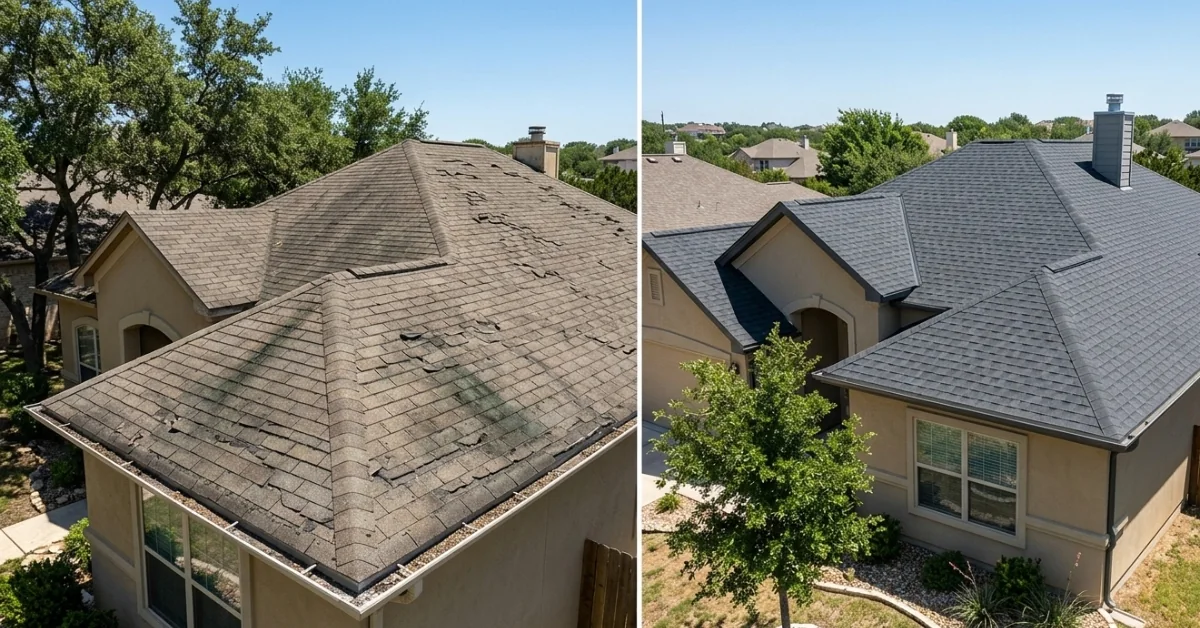
When roofing manufacturers publish warranty periods, 30 years, 40 years, lifetime, those numbers are based on testing conditions that don’t fully account for Austin’s specific climate profile. A shingle product warranted for 30 years in the Pacific Northwest may perform meaningfully differently on a south-facing roof in Westlake Hills or Cedar Park, where it absorbs intense UV radiation for 300+ days per year, faces temperature swings from freezing nights to 110-degree afternoons, and contends with hail storms multiple times per decade.
Understanding how long your roof actually lasts in Austin’s climate, and what drives the variance, is the foundation for making smart decisions about when to replace, what material to choose, and how to maximize the return on your roofing investment.
Realistic Roof Lifespans by Material in Austin TX
These are realistic Austin-specific ranges, not manufacturer warranty periods. Your specific roof may fall above or below these ranges depending on the factors covered in the next section.
The 6 Factors That Most Affect Roof Lifespan in Austin
1. Roof Orientation and Pitch
This is the single biggest variable in how quickly your Austin roof ages. South and west-facing roof slopes receive the most intense UV radiation, particularly from 10 AM to 4 PM when the sun is highest and hottest. A south-facing steep pitch in Austin can age 30 to 40 percent faster than a north-facing shallow pitch on the same house. If your home has multiple roof sections, you’ll often see dramatically different aging on south versus north exposures.
Pitch matters too. Steeper pitches shed water and debris more effectively, reducing the time moisture sits against shingles. Low-pitch roofs, 3:12 and below, accumulate debris, retain moisture longer, and are more vulnerable to wind-driven rain infiltration under the shingles.
2. Attic Ventilation
This is the most consistently overlooked factor in Austin roof longevity. An under-ventilated attic in Austin’s climate traps heat that radiates upward and cooks the shingles from below. While temperatures outside might be 100 degrees, a poorly ventilated attic can reach 150 to 160 degrees, and that heat accelerates the thermal breakdown of asphalt binders in the shingle dramatically.
Proper attic ventilation, a balanced system of soffit intake vents and ridge exhaust vents, can meaningfully extend shingle lifespan in Austin’s climate. If your attic runs hot in summer and your roof seems to be aging faster than expected, ventilation is the first thing to evaluate.
3. Hail History
Austin’s active hail environment is one of the most significant roof-life variables in our area. A roof that has been through three or four significant hail events will have substantially less remaining granule coating than one installed the same year that was spared major hail exposure. Granule loss directly accelerates UV degradation, a roof that looks fine from the street may be 5 to 8 years closer to failure than its installation date would suggest.
This is why post-storm professional inspections matter even when damage isn’t visible from the ground. For a detailed look at how we assess hail damage in Cedar Park specifically, see our guide on storm damage roofing in Cedar Park TX.
4. Installation Quality
A quality shingle installed incorrectly will underperform a mediocre shingle installed correctly. Installation factors that most affect lifespan in Austin’s climate include:
- Nail placement, nails driven too high on the shingle create a hinge effect that causes premature seal strip failure and shingle movement in wind events
- Starter strip installation, missing or incorrectly placed starter strips leave the first course of shingles vulnerable to wind uplift at the eave
- Underlayment quality, synthetic underlayment significantly outperforms felt in Austin’s heat; improper lapping creates moisture pathways
- Flashing installation, improper step flashing, chimney flashing, and valley flashing are the most common sources of premature roof failure and interior moisture damage
5. Material Quality and Warranty Tier
Within any shingle category, there are meaningful quality differences. Entry-level and premium architectural shingles may carry similar warranty periods on paper, but the underlying material specs, fiberglass mat weight, asphalt coating thickness, granule quality, differ significantly. In Austin’s demanding climate, those differences translate to real performance variance over the shingle’s life. For a full breakdown of how material quality affects total roof investment, see our guide on how much a new roof costs in Austin TX.
6. Tree Cover and Debris
Homes with significant tree cover, particularly in neighborhoods like Westlake Hills, Rollingwood, and Lost Creek, face accelerated roof aging from debris accumulation in valleys and gutters, shade conditions that keep moisture against shingles longer, and the risk of branch impact during storms. Regular gutter and valley clearing is essential maintenance for these homes.
Austin Roof Lifespan by Neighborhood Type
| Neighborhood Type | Primary Lifespan Factors | Typical Outcome |
|---|---|---|
| West Austin (Westlake Hills, Rollingwood, Lost Creek) | Mature canopy, shaded exposures, debris accumulation | Slightly shorter on north/east faces; biological growth accelerates |
| North Austin (Cedar Park, Leander, Steiner Ranch) | High hail exposure, open lots, intense UV | Hail history is the dominant variable; Class 4 makes a meaningful difference |
| East/South suburbs (Pflugerville, Round Rock) | Newer construction, less canopy, high UV | UV and heat are primary stressors; ventilation quality matters significantly |
| Established central Austin neighborhoods | Mixed vintage, urban heat island effect | Ventilation quality in older homes is frequently inadequate |
How to Tell If Your Austin Roof Is Near the End of Its Life
- Significant granule loss, visible dark patches on the shingle surface, or heavy granule accumulation in gutters, indicate the UV-protective coating is depleted
- Cupping or curling shingle edges, the shingle mat has dried out and begun to deform from UV and thermal degradation
- Visible cracking, across the shingle mat or at the edges, indicating the asphalt binder has become brittle
- Algae streaking, persistent dark staining from algae growth, accelerating granule deterioration on shaded north and east exposures
- Active attic moisture, wet insulation, water stains on sheathing, or visible daylight from inside the attic indicate active failure requiring immediate attention
If you’re seeing multiple signs from this list, a professional inspection is the right next step. Our guide on what Westlake Hills homeowners should know before replacing their roof covers the repair versus replacement decision framework in detail, the same principles apply to homes across Austin.
When to Replace vs. When to Repair
Repair is appropriate when:
- Damage is limited to a clearly defined small area, less than 10 percent of the total roof surface
- The surrounding shingles are in demonstrably good condition with significant remaining life
- The roof is less than 15 years old and has not been through multiple significant hail events
- The leak source is isolated, a failed pipe collar, lifted flashing at a wall, or a small area of wind-lifted shingles
Replacement is appropriate when:
- The roof is approaching or past 20 years old, particularly if it has been through multiple hail events
- Damage is widespread, affecting multiple sections or representing more than 25 percent of the roof surface
- You’re dealing with recurring leaks from multiple locations, indicating systemic failure rather than isolated damage
- Insurance is covering storm damage, if insurance is paying for replacement, repair spending that defers the inevitable doesn’t make financial sense
- The roof already has two layers of shingles, a two-layer tear-off is required regardless, making full replacement the logical scope
Which Roofing Material Makes the Most Sense for Austin?
- Planning to sell within 10 years: Quality architectural shingles, or Class 4 impact-resistant for the insurance savings. Best ROI for a shorter horizon.
- Planning to stay 15 to 20+ years in a high-hail area: Class 4 impact-resistant shingles. Insurance discounts typically pay back the difference within a few years.
- Long-term homeowner who wants to install one more roof: Standing seam metal. Higher upfront cost, 40 to 70-year lifespan, minimal maintenance, and meaningful energy efficiency from solar heat reflectivity in Austin’s long summers.
- Mediterranean or Hill Country contemporary architecture: Clay tile. Highest upfront cost, longest lifespan, and architectural appropriateness that no other material can match for certain home styles.
For a full side-by-side comparison of metal versus shingles specifically, see our guide on metal roof vs shingle roof for Austin TX homes.
Why Choose Tex Land Construction for Your Austin Roof
- 5.0 Google rating, real reviews from homeowners across Westlake Hills, Cedar Park, Steiner Ranch, Rollingwood, Leander, Round Rock, and the surrounding communities
- BBB Accredited Business, transparent pricing and ethical practices on every project
- Fully licensed and insured in Texas, general liability and workers’ compensation on every project
- Honest repair vs. replacement assessments, we tell you what your specific roof actually needs, not what generates the largest job for us
- Insurance claim experience, we work alongside adjusters on storm damage claims across Austin’s communities
- 5% discount for military veterans, first responders, and senior homeowners
Visit our service areas page to find your community, or call us at 512-808-6882 to schedule your free roof inspection.
Frequently Asked Questions
How long do architectural shingles last in Austin TX?
Realistically, 22 to 32 years in Austin’s climate, less than the 30-year warranty period printed on the package, because Austin’s UV intensity, hail exposure, and temperature extremes are more demanding than the conditions those warranties are tested against. Proper attic ventilation, north or east roof orientation, and limited hail history push toward the top of that range.
How often should I have my Austin roof inspected?
We recommend a professional inspection after any hail event where stones of 3/4 inch or larger were reported in your area, regardless of whether you can see damage from the ground. Beyond storm events, an inspection every 3 to 5 years is reasonable for a roof in the second half of its service life. Inspections are free at Tex Land Construction and come with written findings.
Does Austin’s heat shorten roof lifespan significantly?
Yes, significantly. Asphalt shingles are petroleum-based products whose binders degrade from UV radiation and thermal stress. Austin’s combination of 300+ days of direct sun per year and summer temperatures that routinely exceed 100 degrees creates roofing conditions that are demonstrably more demanding than most other U.S. markets.
Can a new roof lower my energy bills in Austin?
Yes, particularly if you’re upgrading from a dark-colored shingle or from a roof with poor attic ventilation. Cool-roof products with reflective granules, standing seam metal with reflective coatings, and any material change that improves attic ventilation can meaningfully reduce the cooling load on your HVAC system during Austin’s long summer season.
Wondering how much life is left in your Austin roof? Call us at 512-808-6882 for a free, no-obligation inspection and honest assessment.
Request Free Inspection Explore Roofing ServicesLet’s talk about your home.
Schedule a free consultation →